
时间规划局
EU can't reach decision on prolonging the use of chemical herbicide glyphosate_我的网站

A |
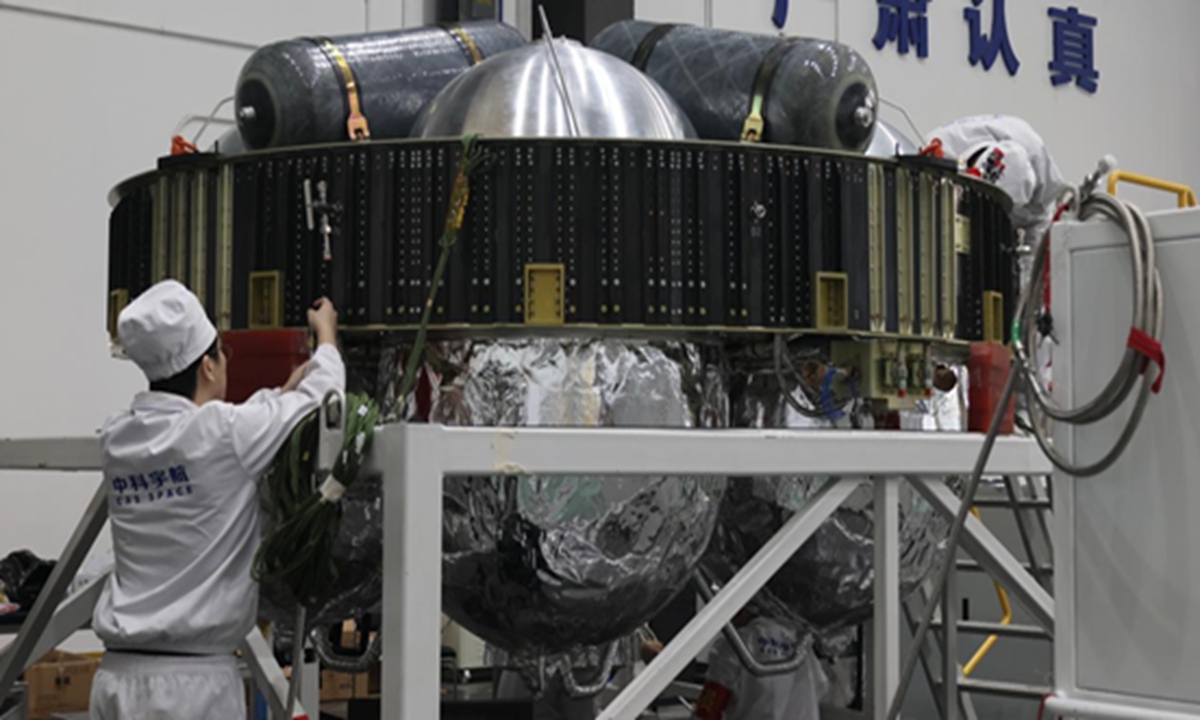
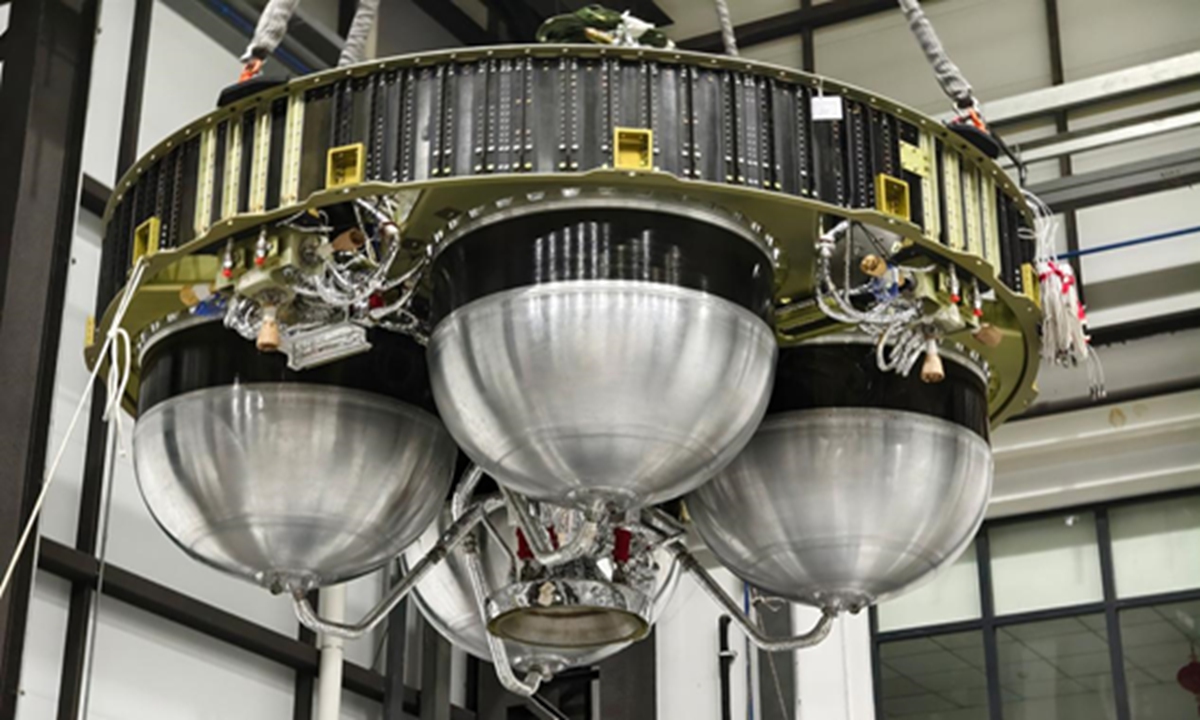
Lixun-1 upper stage, a versatile "space tug" developed by China's commercial space firm CAS Space, is scheduled to make its maiden flight in the first quarter of 2027 after completing a series of key propulsion-system tests, the developer and its chief designer told the Global Times on Tuesday.
The "tug" is designed to ferry satellites from one orbit to another and support missions ranging from constellation deployment to lunar exploration.
While the main stages of a rocket carry payloads from the ground into an initial orbit, an upper stage takes over once the craft is in space. By repeatedly restarting its engine and changing orbit, Lixun-1 can deliver satellites to higher or different orbits, distribute multiple spacecraft to separate destinations during a single launch, or send probes onto trajectories toward the moon and beyond, Global Times learned from the developer.
Yang Haoliang, chief designer of the Lixun-1 upper stage, compared the system to a shuttle service. "If the regular stages of a launch vehicle are like a long-distance bus," - they carry the upper stage and satellites from Earth to a near-Earth parking orbit - the upper stage then takes over as a "space tug," carrying its satellite "passengers" onward to their designated orbital "stops," Yang explained.
That capability can have a direct impact on how efficiently satellites are launched and operated, Yang said. If a satellite has to climb from an initial orbit to its final destination using its own engine, the process can consume a considerable amount of onboard propellant and reduce the fuel available during its operational life. An upper stage can instead perform that orbital transfer, helping conserve satellite fuel and potentially extend its service life.
It can also make one rocket launch do more work. Instead of releasing a batch of satellites into roughly the same orbit, Lixun-1 can repeatedly ignite its engine and maneuver between deployments, sending different satellites to different altitudes and inclinations. Yang said this would help accelerate constellation deployment while improving the efficiency of individual launches.
The practical ambitions behind the system are backed by a major technical milestone reached this month. In August, Lixun-1 completed its PV-001 integrated propulsion-system coordination firing test, during which the entire system operated smoothly for 566 seconds.
Yang told the Global Times that the current Lixun-1 upper stage has a thrust of 20 kilonewtons and can achieve a specific impulse of 315 seconds, which he described as reaching an internationally leading level. The August firing covered the planned profile for the maiden mission, an important step before the system proceeds to flight testing.
The test was more than a demonstration of the engine itself. As an important system-level verification during development, it examined the coordination and engineering reliability of the engine pressurization system, propellant delivery system, propellant management system and servo-control system under the fully integrated configuration.
Of a series of tests that accumulated 5,211 seconds of firing time, the latest one focused on three core technologies: a high-thrust, high-performance 20-kilonewton upper-stage engine capable of multiple starts; balanced propellant delivery from multiple parallel tanks; and a highly reliable integrated electrical system. Their successful verification means Lixun-1 has completed its system-level testing and is ready to move into the flight-test phase, according to the developer.
Lixun-1 has been designed as a modular and generally adaptable upper stage rather than a system tied to only one rocket. It is intended to work with CAS Space's Kinetica-2 and Kinetica-2 heavy-lift variants as well as other launch vehicles, Yang said.
When paired with the Kinetica-2 family, Lixun-1 could significantly expand the rocket's mission range. For communications missions, it could deliver satellites to geosynchronous transfer orbit or even directly to geosynchronous orbit, conserving satellite propellant while supporting the deployment of high-throughput satellites and future 6G communications spacecraft.
For multi-satellite missions, the combination could distribute spacecraft to different orbital altitudes and inclinations during a single launch, potentially serving both low-Earth-orbit constellations and medium- or high-orbit payloads. For deep-space missions, it could place probes onto Earth-moon transfer trajectories and support lunar exploration, Yang said.
The upper stage is designed to be able to conduct more than 20 engine ignitions, autonomously plan orbital-transfer routes and operate under the vacuum and extreme temperature conditions of space. After completing payload deployment, it can also carry out orbital disposal maneuvers to reduce space-debris risks.
Yang said the Lixun-1 and Kinetica-2 combination is designed to cover the vast majority of commercial satellite launch requirements while retaining the ability to participate in major national space projects. More broadly, the upper stage forms part of CAS Space's effort to build launch capabilities reaching medium and high Earth orbits and deep space, extending the reach of China's commercial space sector toward higher orbits and more distant destinations.
。

B | BRUSSELS -- A European Union decision on whether to authorize the use of the controversial chemical herbicide glyphosate in the 27-nation bloc for at least 10 more years was delayed for a month after member countries failed to agree on Friday.The chemical, which is widely used in the 27-nation bloc, is approved on the EU market until mid-December. Representatives of the EU’s executive arm and member countries voted Friday in favor of renewing its authorization until 2033, despite protests from environmental groups. But to be adopted, the 10-year extension proposed by the European Commission required a “qualified majority,” defined as 55% of the 27 members representing at least 65% of the total EU population of some 450 million people. Several member states abstained, and that was not achieved. The European Commission is now expected to amend its proposal before another vote takes place next month. Ultimately, if no consensus is found, the Commission will have the final say.Green members of the European Parliament welcomed the delay and urged member states to vote for a complete ban of glyphosate.“It is irresponsible to again renew the authorization of the use of glyphosate,” said Bas Eickhout, the vice-chair of the Parliament's environment committee. "This would give the big agri a blank check to earn billions by selling a pesticide for which there are still big gaps in knowledge about the effects on our health, and at the same time poses large risks for European biodiversity.”Over the past decade, glyphosate, used in products like the weedkiller Roundup, has been at the heart of heated scientific debate about whether it causes cancer and its possible disruptive effect on the environment. The chemical was introduced by Monsanto in 1974 as an effective way of killing weeds while leaving crops and plants intact.The France-based International Agency for Research on Cancer, which is part of the World Health Organization, classified it as a “probable human carcinogen” in 2015. The EU’s food safety agency had paved the way for the 10-year extension when it said in July it “did not identify critical areas of concern” in the use of glyphosate. The U.S. Environmental Protection Agency found in 2020 that the herbicide did not pose a health risk to people, but a federal appeals court in California ordered the agency last year to reexamine that ruling, saying it wasn’t supported by enough evidence.EU member states are responsible for authorizing the use of products including the chemical on their national markets, following a safety evaluation.In France, President Emmanuel Macron had committed to ban glyphosate before 2021 but has since backpedaled. Germany, the EU's biggest economy, plans to stop using it from next year, but the decision could be challenged. Luxembourg’s national ban, for instance, was overturned in court earlier this year.Greenpeace had called on the EU to reject the market reapproval, citing studies indicating that glyphosate may cause cancer and other health problems and could also be toxic to bees. The agroindustry sector, however, claims there are no viable alternatives.“Whatever the final decision that emerges from this re-authorization process, there is one reality that member states will have to face up to,” said Copa-Cogeca, a group representing farmers and agricultural cooperatives. “There is as of yet no equivalent alternative to this herbicide, and without it, many agricultural practices, notably soil conservation, would be rendered complex, leaving farmers with no solutions.”。
Current article:http://6ayu2i.cuntoujuefourantapai.cfd/j30cbzt/dqfno8.html
Published on:06:44:07
- Georgia Arrest Strips ‘Special Status’ From Trump
- 猜猜苹果iPhone的第三个摄像头在2019年会做什么?
- “突击队”助高铁项目攻坚
- CES上的汽车激光雷达非常强大,以至于有人声称他们价值数万美元的相机被摧毁了。
- 9秒39!中国机器人打破由博尔特保持的9秒58人类百米世界纪录
- 智界赵长江:现在不买 L3 就像当年不买 5G 手机
- 美国股市连续第三个交易日上涨:1家制药公司股价飙升36%,微博下跌5.6%。
- 山西2人因严重违纪违法接受审查调查_尧都区_潘亚军
- 第30届鲁台经贸洽谈会将于近期举办,国台办介绍相关情况
- 公寓式组屋以132万元转售 创宏茂桥新纪录